About this Edition
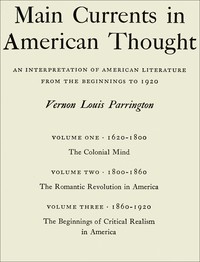
"Main currents in American thought" by Vernon Louis Parrington is a critical history of American literature and ideas written in the early 20th century. The study interprets American writing through the lenses of political, economic, and social change, tracing how European doctrines took root and reshaped themselves in the New World. It centers on the long contest between liberal-democratic impulses and conservative-theocratic or capitalistic systems, with Volume One probing the clash of Puritan theocracy and emerging Yankee individualism in colonial New England. The opening of the work lays out a frankly liberal, Jeffersonian vantage point and explains that the inquiry follows ideas as they evolve through theology, politics, and economics rather than through belletristic schools. The introduction maps the European bequests—English Independency (natural rights), French romantic theory and Physiocracy (equality, agrarianism), and English laissez faire (commercial individualism)—and frames colonial thought as a struggle among figures like Roger Williams, Franklin, and Jefferson on one side and John Cotton, Jonathan Edwards, and Alexander Hamilton on the other. It argues that colonial literature is best understood in its polemics on church and state. Beginning Book One, the narrative shows New England shaped by freehold landholding and a mercantile spirit, producing yeomanry and gentry and the dual ideals of Puritan and Yankee. It then sketches English backgrounds: Puritanism as
Subjects & Topics
American literature -- History and criticismPhilosophy, AmericanUnited States -- CivilizationUnited States -- Intellectual lifeUnited States -- Politics and governmentUnited States -- Religion