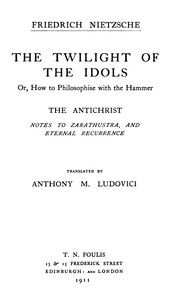
Cover of The Twilight of the Idols; or, How to Philosophize with the Hammer. The Antichrist: Complete Works, Volume Sixteen by Friedrich Wilhelm Nietzsche
Public domain title via Project Gutenberg
Category: Philosophy & Ethics Verified Public Domain

The Twilight of the Idols; or, How to Philosophize with the Hammer. The Antichrist: Complete Works, Volume Sixteen

By Friedrich Wilhelm Nietzsche

"The Twilight of the Idols; or, How to Philosophize with the Hammer" by Friedrich Nietzsche is a philosophical treatise written in the late 19th century. This work serves as a critical examination of traditional values in Western philosophy and morality, articulating Nietzsche's call for a…

Catalog ID Project Gutenberg eBook #52263
Language English
Archive Source Project Gutenberg
Access Level 100% Free & Private

About this Edition

"The Twilight of the Idols; or, How to Philosophize with the Hammer" by Friedrich Nietzsche is a philosophical treatise written in the late 19th century. This work serves as a critical examination of traditional values in Western philosophy and morality, articulating Nietzsche's call for a profound reassessment and "transvaluation" of these values. Central to the work is the idea that many long-held beliefs, particularly those stemming from religious and moral doctrines, have become idols that require destruction to clear the way for a more life-affirming philosophy. The opening of "The Twilight of the Idols" sets the stage for Nietzsche's sweeping critique of societal norms and philosophies that undermine individual strength and vitality. It features a translator’s preface that provides background on the work's brief composition timeframe and its significance in Nietzsche's oeuvre. The preface emphasizes Nietzsche's intent to challenge entrenched beliefs that he sees as harmful, claiming that the "old truth" is becoming irrelevant as humanity faces a new and empowered understanding of existence. Nietzsche expresses his conviction that current interpretations of morality do not serve life but rather promote a stance of decay and resentment against it. Throughout this groundwork, the author foreshadows the profound arguments he will present in the subsequent sections, illuminating his vision to invigorate human potential. (This is an automatically generated summary.)

Subjects & Topics

PhilosophyCategory: Philosophy & Ethics